
India’s new trade agreement with the United Kingdom is now live. From July 15, 2026, the India-UK Comprehensive Economic and Trade Agreement, commonly called CETA or the India-UK FTA, begins moving from policy headlines into actual business decisions.
The short version: Indian exporters get duty-free access to the UK on about 99% of export lines, the services sector gets stronger market access, professionals get relief from double social security contributions under the Double Contribution Convention, and Indian consumers could gradually see more UK products enter the market at lower duties.
That does not mean every product gets cheaper overnight. Trade deals work through rules of origin, quotas, customs procedures, documentation and product-specific tariff schedules. But for Indian textiles, footwear, engineering goods, processed foods, marine products, IT services, professional services and MSMEs, this is one of the most important trade stories of the year.
Quick answer: what changed on July 15, 2026?
The India-UK FTA entered into force on July 15, 2026. It gives nearly all Indian exports duty-free access to the UK, expands opportunities for Indian service providers, and activates the Double Contribution Convention so eligible temporary professionals do not pay social security contributions in both countries for the same posting.
For Indian businesses, the biggest opportunity is not just lower tariffs. The real advantage is predictability: clearer trade rules, faster customs processes, digital trade commitments, more transparent information for SMEs, and a stronger framework for long-term India-UK commerce.
Why the India-UK FTA matters
India and the UK already have a deep trade, education, technology and diaspora relationship. The new agreement adds a more formal economic corridor to that relationship.
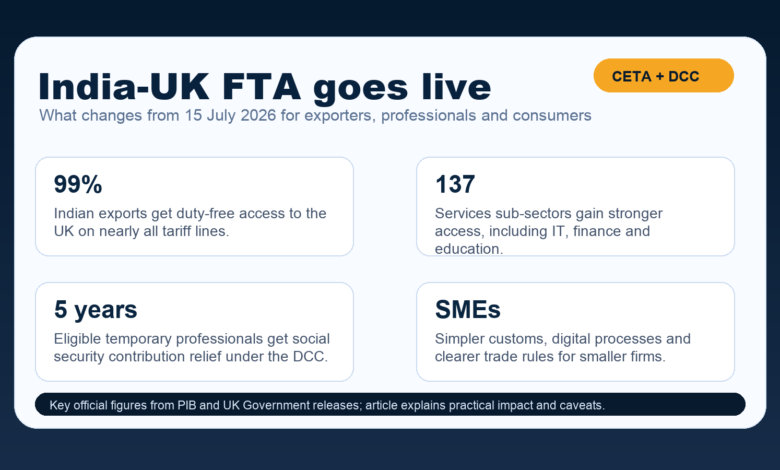
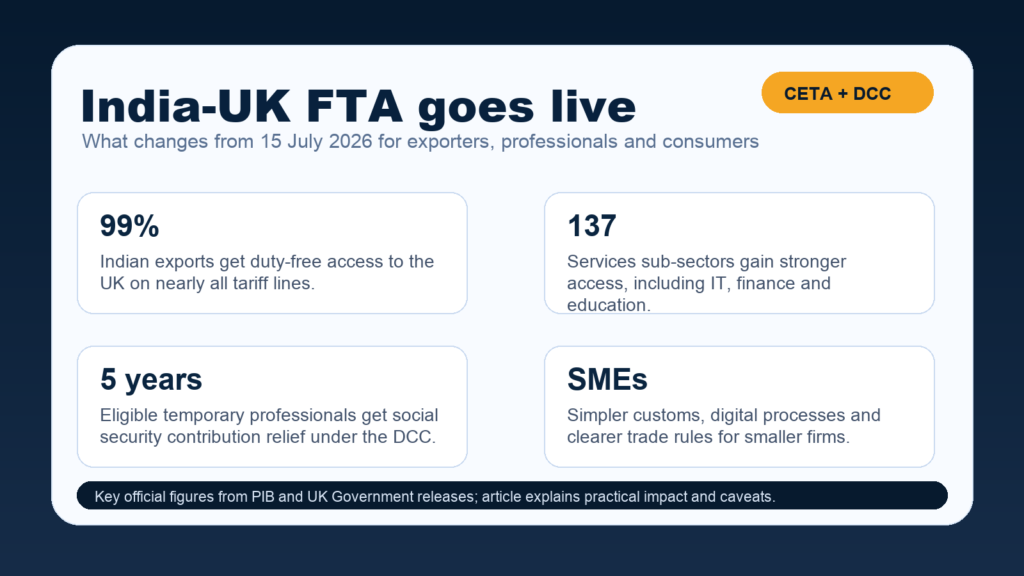
According to the Government of India’s Press Information Bureau, CETA provides zero-duty access on about 99% of India’s exports to the UK, covering nearly the entire value of trade. PIB also says the services package spans 137 sub-sectors, including IT/ITES, professional services, education, business services and financial services.
The UK Government has described the deal as one of the most comprehensive trade agreements India has brought into force, with long-term forecasts pointing to higher bilateral trade and GDP gains for both countries.
For readers, the simplest way to understand the deal is this: India wants its manufacturers, service providers, MSMEs and skilled professionals to compete more easily in a high-value market, while the UK wants stronger access to India’s fast-growing consumer and business economy.
What Indian exporters gain
The clearest win is for Indian goods going to the UK. Tariffs that made Indian products more expensive in Britain are being removed across several export-heavy sectors.
PIB says tariffs will be reduced to zero for several Indian export categories, including processed food products, marine products, engineering goods and auto components, leather and footwear, textiles and clothing, chemicals and pharmaceutical products.
That matters because many of these sectors are labour-intensive. Lower tariffs can help Indian exporters compete not only on price, but also on quality, speed and reliability. For a textile manufacturer in Tiruppur, a leather exporter in Kanpur, a seafood processor in Kerala, or an engineering goods supplier in Gujarat, a lower-tariff route into the UK can improve margins or make pricing more competitive.
The agreement could also help Indian MSMEs that previously found cross-border trade too complicated. The UK Government’s business guidance says the deal supports simpler customs, digital processes, clearer rules and better online trade information. These details sound boring, but they are often what decide whether smaller firms can actually use a trade agreement.
The services story: IT, finance, education and professional work
For India, services are as important as goods. India is already a global force in IT, outsourcing, consulting and digital services. CETA gives Indian service providers greater certainty in the UK market.
PIB says the agreement covers 137 services sub-sectors of export interest to India. These include IT and IT-enabled services, financial services, professional services, healthcare, education, engineering, telecommunications and consultancy services.
The deal also creates clearer pathways for business visitors, intra-corporate transferees, contractual service suppliers, independent professionals and investors. This does not replace immigration law or create automatic open migration, but it gives businesses more predictable mobility rules for specific professional use cases.
For Indian IT companies, the Double Contribution Convention is a major practical benefit. Eligible temporary workers posted to the UK can get relief from paying social security contributions in both countries. PIB says the exemption period has been extended from three years to five years, and more than 75,000 Indian professionals and over 900 companies are expected to benefit.
What consumers in India may notice
The consumer side will attract attention because of UK goods such as Scotch whisky, premium cars, cosmetics, chocolates and other products.
However, consumers should be careful with expectations. A tariff cut is not the same thing as an instant retail price cut. Final prices depend on importers, distributors, state taxes, logistics, brand pricing, currency movement and whether a product meets the agreement’s rules.
The Economic Times reported that duties on qualifying premium alcoholic beverages will start reducing in phases, while Scotch whisky duties are expected to fall further over time. It also reported phased tariff changes for UK automobiles, including quota-based concessions.
So yes, some UK imports may become more accessible over time. But the more immediate economic impact is likely to be felt by businesses, exporters, services firms and professionals rather than by shoppers the next morning.
Why rules of origin matter
Trade deals can be misused if companies route goods through a partner country only to claim lower tariffs. That is why rules of origin are important.
Rules of origin decide whether a product genuinely qualifies as Indian or British under the agreement. If a product is mostly made in a third country and only minimally processed in India or the UK, it may not qualify for preferential duty treatment.
For Indian exporters, this means documentation becomes critical. Businesses will need to track inputs, manufacturing processes and origin declarations properly. A company that understands compliance will gain more from the FTA than one that treats it as a simple discount code.
Sectors that could benefit most
The strongest Indian opportunities appear to be in labour-intensive and export-oriented industries.
Textiles and clothing could gain because UK tariffs on many Indian apparel products are being removed. Footwear and leather exporters could use the deal to compete more aggressively in the UK market. Marine products and processed foods could benefit from lower barriers if quality and compliance standards are met. Engineering goods, auto components, chemicals and pharmaceuticals also stand to gain from lower tariffs and deeper market access.
Services may be the bigger long-term story. India’s IT, consulting, finance, education and professional services sectors already have global credibility. With clearer access rules and DCC relief, the UK becomes a more predictable expansion market.
For startups and digitally enabled businesses, the agreement also matters because trade is no longer only about containers and ports. Digital trade, intellectual property, professional mobility, contracts and cross-border services are now central to growth. That is also why India’s startup ecosystem, which we have covered in our post on India's top startups, should watch the deal closely.
The caveats: what the deal does not solve
The India-UK FTA is a major opening, but it is not a magic switch.
First, exporters still need to meet UK standards, certification rules, quality expectations and buyer requirements. Duty-free access will not help a product that fails compliance or branding.
Second, sensitive sectors remain protected. PIB says India has protected areas such as dairy products, cereals, millets, edible oils, oilseeds, apples and several vegetable products. This is important because trade liberalisation can create domestic pressure if sensitive rural sectors are opened too quickly.
Third, some benefits are phased. Products like automobiles and premium alcohol have schedules, quotas or product-specific conditions. The biggest benefit may take years to fully show in retail prices.
Fourth, the deal arrives in a competitive global environment. Indian businesses still have to compete with suppliers from Bangladesh, Vietnam, China, the EU and other markets. The FTA improves access, but competitiveness still depends on design, quality, supply chain speed, branding and reliability.
What Indian businesses should do now
Indian exporters and service providers should not wait for the market to move by itself. The firms that benefit most will be the ones that act early.
Here is the practical checklist:
- Check whether your product or service is covered under the relevant CETA schedule.
- Review tariff changes for your specific HS code or service category.
- Prepare rules-of-origin documentation before making pricing promises to buyers.
- Speak with customs, trade compliance or export consultants if your product has mixed inputs.
- Build UK-facing sales pages, catalogues, certifications and buyer outreach material.
- For services, review mobility provisions and DCC eligibility before sending professionals.
- Use the FTA as a marketing point, but do not overclaim benefits that depend on compliance.
Why this is a hot topic in India right now
The timing is why the India-UK FTA is trending. It is not just another diplomatic announcement; it is entering force today, July 15, 2026. That means exporters, importers, IT firms, professionals, customs teams and policy watchers are all trying to understand what changes from day one.
For India, the deal is also symbolic. It shows a shift from broad globalisation talk to targeted economic agreements that combine goods, services, professionals, digital trade, SMEs and sensitive-sector protection.
If implemented well, the agreement can help India move beyond low-cost exports toward higher-value trade relationships. If implementation is weak, the opportunity will remain on paper. The difference will come down to how quickly Indian businesses translate the agreement into contracts, compliance and market expansion.
FAQ
What is the India-UK FTA?
The India-UK FTA, formally called the Comprehensive Economic and Trade Agreement or CETA, is a trade agreement between India and the United Kingdom. It reduces tariffs, improves market access, supports services trade and creates clearer rules for businesses and professionals.
When did the India-UK FTA come into force?
The agreement entered into force on July 15, 2026.
What does 99% duty-free access mean?
It means about 99% of India’s export lines to the UK get duty-free access under the agreement, subject to the relevant rules, schedules and origin requirements.
Will UK whisky and cars become cheaper in India?
Some duties are being reduced in phases, but retail prices may not fall immediately. Final consumer prices depend on tariff schedules, quotas, importers, state taxes, distribution costs and brand pricing.
Who benefits most from the India-UK FTA?
Indian exporters in textiles, footwear, marine products, processed foods, engineering goods, chemicals, pharmaceuticals and auto components could benefit. Service providers in IT, finance, education, consulting and professional services may also gain from stronger access and mobility provisions.
What is the Double Contribution Convention?
The Double Contribution Convention is the social security agreement linked to the FTA. It helps eligible temporary professionals avoid paying social security contributions in both India and the UK for the same posting, with the exemption period extended to five years.
Sources and further reading